What happens today
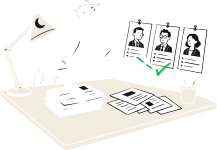
The patchwork
- A gut feeling that "it should work over there too"
- One agency deck built on a country you have never sold in
- A focus group you cannot afford until after launch
- A local hire who joins the week the campaign ships
Simulate playbook
Spot what does not translate before you spend a penny.

The number
You walk into launch knowing which lines land in the new market and which ones to rewrite, before the media spend, not after.
Cultural fit
The situation
Hand Simulate the messaging you already run at home and the country you are entering. It spins up simulated customers from that market (with local values, references, and reflexes) and puts your copy in front of them. You see what lands, what confuses, and what quietly offends before a single ad goes live.
What happens today
With Simulate
How the work moves
Simulate runs your existing messaging past a market you have never sold in and shows the reaction line by line. Skip freely once you know which parts of your copy carry the risk.
Simulate at work
One brief travels through the whole job. Context stays attached until the finished work lands.
Frame
Simulate starts with your real copy and the target country, and asks only for what is missing: no translation brief, no lengthy cultural questionnaire.
Populate
Hundreds of typed agents with local values, references, and social graphs: buyers, not demographics. Each carries the knowledge and reflexes of the market you have not sold in yet.
React
Your messaging goes in front of the swarm and the reactions rank by line. The claim that reads as confident at home may read as pushy abroad, and Simulate names why.
Read
A packaged read lands in the format your team already uses: keep, rewrite, or cut, with the reasoning attached. You fix the messaging on paper, not in market.
Prompts worth keeping
Three prompts, a kickoff, a full run, and a packaging pass. Copy the one that matches the phase you're in. Swap in your own market and messaging.
You are Simulate. I am entering a new market and want to rehearse it before I spend. Here is the messaging I run at home: [paste your headlines, taglines, and ad copy]. The country I am entering is [target market]. Build simulated customers from that market and walk me through the first move: tell me what you need from me.
Run the full playbook end-to-end for [target market]: build hundreds of local simulated customers, put my existing messaging in front of them, and show me line by line what lands, what confuses, and what offends. Rank the reactions and name the cultural reason behind each one. Ask before skipping any step, and show your work as you go.
Deliver the output as a single cultural-fit read I can share with the team: lead with the verdict on whether this messaging is ready for [target market], then the receipts: which lines to keep, which to rewrite, and which to cut, each tied to how the simulated customers reacted.
What goes in. What comes back.
Simulate runs on the inputs on the left and hands back the artifacts on the right. Skip any input, the agent will ask for it the first time it needs it.
The finished artifact
Every run ends the same way, a packaged read in the channel your team already reads. Here's a preview of what shows up.
Simulate → your team
playbooks
Tue 9:12 AM
Here's the read for the market you're entering. I built simulated customers from the target country, ran your existing messaging past them, and flagged every line that lands, confuses, or offends, with the cultural reason attached.
What moved
Cultural fit
You walk into launch knowing which lines land in the new market and which ones to rewrite, before the media spend, not after.
cultural-fit.pdf · line-by-line.csv · rewrites.md
Before you run it
Three ways we see this go sideways and how to avoid each one.
Keep judgment with the team. The playbook should make the work clearer, not hide the assumptions behind it.
Questions
No. Feed Simulate the copy exactly as you run it today and name the market you are entering: the simulated customers react in their own cultural frame. If you already have a translated version, run both so you can see whether the translation kept what made the original land.
A focus group gives you a handful of people after you have already booked the market. Simulate builds hundreds of typed customers from the target country in minutes, so you see what lands, confuses, or offends before you spend, and you can rerun the moment you change a line.
It is qualitative on purpose, because what kills a launch abroad is rarely a number: it is a line that reads as pushy, a reference nobody gets, or a joke that offends. Simulate ties every reaction to a specific simulated customer and names the cultural reason, so the read is traceable even when it is not a percentage.
Whoever owns the market entry: usually the growth or marketing lead running the launch. They take the keep / rewrite / cut list into the campaign, while a local reviewer or regional hire sanity-checks the final rewrites before the spend goes live.